
The Sacrament is the channel by which we receive the grace and blessing of the Holy Spirit, that are essential for our salvation.
- The Lord Christ institute all these Sacraments by Himself.
- “Butthe Helper, the Holy Spirit, whom the Father will send in My name, He will teach you all things, and bring to your remembrance all things that I said to you.” John 14: 26
- To accomplish the seven sacraments, there are 3 essential conditions in order to administer them: 1- suitable substance for the sacrament like water for baptism and also bread and wine for the sacrament of communion . 2- An ordained priest by the laying on of the apostolic hand . 3- Invocation of the Holy Spirit by the priest, by praying certain prayers for the dwelling of the Holy Spirit and sanctification of the sacrament
- There are four redemptive sacraments out of the seven sacraments.
They are necessary fir eternal salvation, and every believer should practice them in order to gain eternal salvation. These are:
- Baptism.
- confirmation.
- Eucharist (Holy Communion).
- Repentance & Confession.
The other three are non-redemptive and unnecessary for eternal salvation.
The Sacrament of Baptism:
“He who believes and is baptized will be saved; but he who does not believe will be condemned.” Mark 16: 16
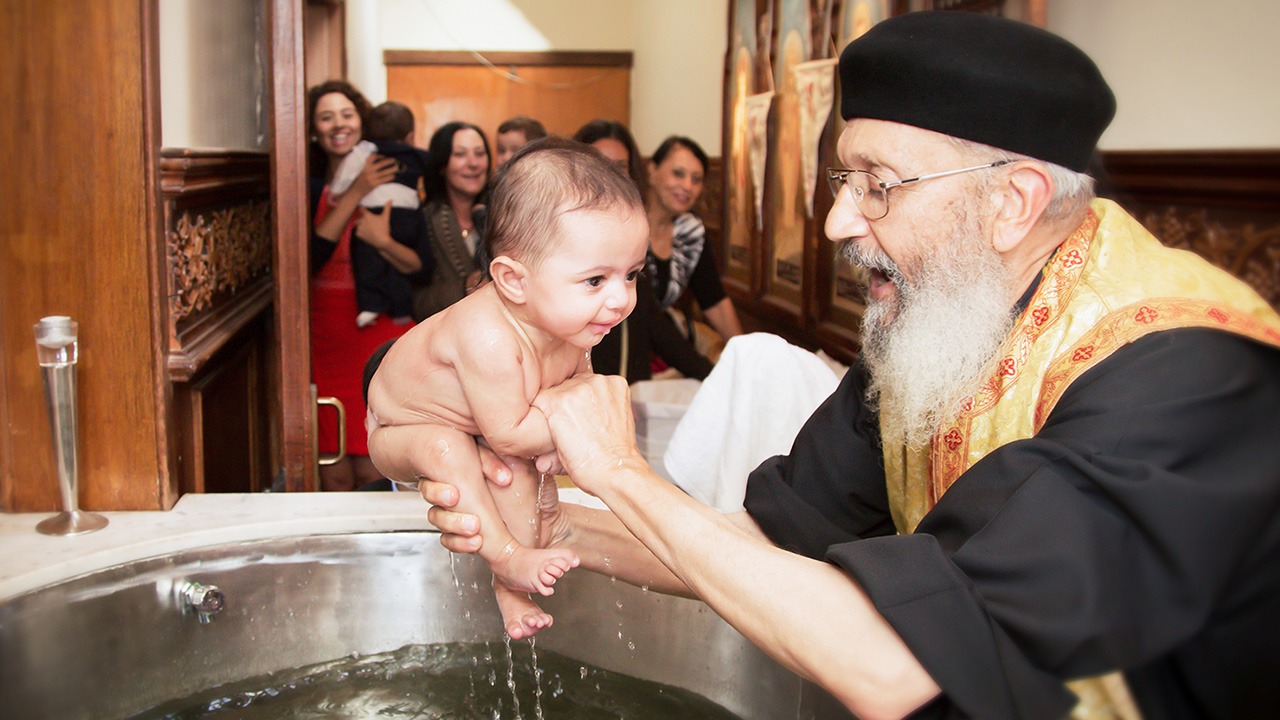
Baptism is the Holy Sacrament through which we are born again by being immersed in water three times in the name of the Holy Trinity: the Father, the Son and the Holy Spirit. The Sacrament of Baptism has the primacy among the Seven Holy Sacraments for it is the door through which the individual enters the Church (as a congregation) and is given the right to partake of the rest of the Sacraments
The Sacrament of Confirmation:
“I will give you a new heart and put a new spirit within you; I will take the heart of stone out of your Flesh and give you a heart of flesh. I will put My Spirit within you and cause you to walk in My Statutes.” (Ezek 36:26-27)
The Holy Sacrament of Confirmation induces us into God’s spiritual army and the lay
priesthood of believers. Our body becomes a temple of the Holy Spirit (1 Cor 6:19) who helps us grow in the spiritual life.
The roots of this Sacrament are clear in both the Old and New Testaments. In his sermon on Pentecost, St. Peter quotes the famous words of Joel the Prophet; “I will pour out My Spirit on all flesh”
(Acts 2:17; Joel 2:28). Other Old Testament prophets who speak of this same promise of the Spirit include Ezekiel (Ezek 16:9; 36:26-27). Moreover, our Lord Jesus Christ instituted this Holy Sacrament through His Various promises for granting the Holy Spirit:
“And I will pray the Father, and He will give you another Helper, that He may abide with you forever –the Spirit of truth, whom the world cannot receive, because it neither sees Him nor knows Him; but you know Him, for He dwells with you and will be in you.” (Jn 14:16-17)
Independence From Baptism:
- “Now when the apostles who were at Jerusalem heard that Samaria had received the word of God, they Sent Peter and John to them, who, when they had come down, prayed for them that they might receive the Holy Spirit. For as yet He had fallen upon none of them. They had only been baptized in the name of The Lord Jesus. Then they laid hands on them, and they received the Holy Spirit.” (Acts 8:14-17)
History of The Holy Oil (Myron ‡ Greek word that means perfume):
Our fathers the Apostles took the spices that were on our Lord’s body in the tomb and the spices that the women had prepared (Lk 24:1), melted all in pure olive oil, and prayed on it. They decreed that this holy oil be used as means of anointing the baptized in order to confirm and give them the gift of the Holy Spirit.
They also decided that their successors, the Bishops, renew the holy oil by adding to the original so that the Churches never run out. When St. Mark came to Alexandria, he brought with him some of that holy oil. In the beginning of the fourth century, H.H. Pope Athanasius the Apostolic, the 20th Pope of Alexandria, decided to renew the holy oil. So he gathered all the spices and perfumes that God had ordered Moses the Prophet to use in making the holy ointment (Ex 30) and added them to the remainder of the holy oil that St. Mark had brought with him to Egypt. St. Athanasius sent some of the holy oil to the Bishops of Rome, Antioch, and Constantinople with the recipe that he used in manufacturing it and they all received it with rejoicing. The holy oil was manufactured 29 times in the Coptic Orthodox Church (thus far).
The Sacrament of The Eucharist (communion)
In the Sacrament of the Eucharist, believers eat Lord Jesus Christ’s Holy Body and drink His Precious Blood under the physical appearance of bread and wine. This Sacrament is called the Sacrament of All Sacraments and/or the crown of the Sacraments. In the Coptic Orthodox Church, no Sacrament is to be Administered (on the same day) after the person has partaken from Holy Communion.
Our Lord instituted this Sacrament on Covenant Thursday, just a few hours before His arrest and Trial. After He had washed the feet of the disciples as a sign of their repentance and preparation, “He took Bread, blessed it and broke it, and gave it to the disciples and said, ‘Take, eat; this is My body.’ Then He took The cup, and gave thanks, and gave it to them, saying, ‘Drink from it all of you. For this is My blood of the New covenant, which is shed for many for the remission of sins’” (Mt 26:26-28)
“I am the living Bread which came down from heaven. If anyone eats of this bread, he will live forever and the bread that I shall give is My flesh” (Jn 6:51)
Our Lord spoke about this Sacrament openly to the Jews but they “quarreled among themselves Saying, ‘How can this Man give us His flesh to eat?’” (Jn 6:52). Moreover, many of the disciples protested saying, “This is a hard saying; who can understand it?” (Jn 6:60). When Lord Jesus explicitly emphasized his real presence in the Sacrament, it was written, “many of His disciples went back and walked with Him no more” (Jn 6:66)
That emphasized ,that The Lord was talking about true flesh and blood not just a symbol.
The Sacrament of Repentance & Confession:
Lord Jesus Christ instituted this Sacrament when He said to His disciples:
- “Assuredly, I say to you, whatever you bind on earth will be bound in heaven, and whatever you loose on earth will be loosed in heaven.” (Mt 18:18)
“Receive the Holy Spirit. If you forgive the sins of any, they are forgiven them; if you retain the sins of Any, they are retained.” (Jn 20:22-23)
“Many who had believed came confessing and telling their deeds.” (Acts 19:18)
+ Stages (Types) of Confession:
- Confession to one’s self: This is the first thing one needs to do as Lord Jesus Christ mentioned in His parable of the Prodigal Son that “he came to himself” (Lk 15:17)
- Confession to God: Once a person acknowledges the sin, he/she should lift up his/her heart and confess this sin to God as King David said, “Against You, You only, have I sinned, and done this evil in Your sight” (Ps 51:4)
- Confession to the priest: This is the practice of the Sacrament of Repentance & Confession where the confessor receives spiritual guidance and forgiveness as St. James said, “Is anyone among you sick? Let him call for the elders (priests) of the Church, and let them pray over him, anointing him with oil in the name of the Lord … Confess your trespasses to one another, and pray for one another, that you may be
healed” (Jam 5:14,16). When St. James says “pray for one another,” he is referring to the priests praying for the sick and when he says, “confess to one another,” he means the sick confessing to the priests.
+++The following Sacraments are not essential for salvation :
The Sacrament of Matrimony:
In the Orthodox Church, this Sacrament is a visible form of an invisible Grace, it’s a mystery, an open door through which mankind passes from the realm of the physical and earthly, Into the reality of the spiritual and heavenly- the realm of communion with God.
- “Wives, submit to your own husbands, as to the Lord … therefore, just as the church is subject to Christ, so let the wives be to their own husbands in everything.” (Eph 5:22,24)
- “Husbands, love your wives, just as Christ also loved the church and gave Himself for it … so husbands ought to love their own wives as their own bodies; he who loves his wife loves himself. For no one ever hated his own flesh, but nourishes and cherishes it, just as the Lord does the church.” (Eph 5:25,28-29)
The Sacrament of the Anointing of the Sick :
There are two Sacraments for ‘healing’; one for spiritual illness, which is the Sacrament of Repentance & Confession, the other for physical and psychological illness, which is the Sacrament of the Anointing of the Sick.
“Anointed with oil many who were sick, and healed them.” (Mk 6:13)
It is understood that the apostles, having been sent by the Lord, were instructed to do so.
St. James also said:
- “Is anyone among you sick? Let him call for the elders (priests) of the church, and let them pray over Him, anointing him with oil in the name of the Lord. And the prayer of faith will save the sick, and the Lord will raise him up. And if he has committed sins, he will be forgiven. Confess your trespasses to one another, and pray for one another, that you may be healed.” (Jam 5:14-16)
The Sacrament of Priesthood:
The Sacrament of Priesthood is the Holy Sacrament by which the Bishop lays his hand on the elected candidate in order for the Holy Spirit to descend on this person to grant him one of the priestly ranks. As a result, the ordained person is granted the authority to perform the ministry of the Church, whether the Holy Sacraments, teaching or others. This process is called “Laying of hands” or “Ordination.”
Lord Jesus Christ instituted this Sacrament when He chose the twelve of His followers and consecrated them for ministry, “He called His disciples to Him, and from them He chose twelve whom He also named apostles” (Lk 6:13). He gave them the authority of absolution and binding, “He breathed on them, and said to them, ‘Receive the Holy Spirit’. If you forgive the sins of any, they are forgiven them; if you retain the sins of any, they are retained” (Jn 20:22-23). Notice that this took place before the Pentecostsand the gift of the Holy Spirit here is the gift of ordination. Only to them He said, “Go therefore and make disciples of all the nations, baptizing them in the name of the Father and the Son and of the Holy Spirit” (Mt 28:19) and only to them He delivered the mystery of His Body and Blood (The Eucharist)
Sources
https://suscopts.org/coptic-orthodox/church/sacraments
And others